
Recovery Star: Developed to address the need for both recovery-oriented practice and measurable outcomes
- Luisa Listens
- Sep 24, 2025
- 15 min read

The recovery paradigm has generated a variety of tools designed to translate values of hope, empowerment, and autonomy into practical frameworks for supporting people with mental health concerns. Among these tools is the Recovery Star, often referred to as the Ten Point Recovery Star, which has become one of the most widely used outcome and planning measures in community mental health services across the United Kingdom, Australia, and beyond. Developed to address the need for both recovery-oriented practice and measurable outcomes, the Recovery Star represents a hybrid model: it is simultaneously a collaborative recovery planning tool and a mechanism for tracking progress over time.
The model distinguishes itself from other recovery frameworks such as the Wellness Recovery Action Plan (WRAP) and the Collaborative Recovery Model (CRM). While WRAP emerged directly from the consumer movement and CRM from academic–clinical partnerships, the Recovery Star was created through collaboration between Triangle Consulting Social Enterprise and the Mental Health Providers Forum in 2006. Its origins were grounded in service settings, with the aim of producing a tool that was practical for frontline workers, meaningful for consumers, and useful for service accountability.
This essay will critically analyse the Recovery Star by tracing its origins and development, examining its key features and attributes, and evaluating the evidence base for its effectiveness. It will also explore its application in a specific service setting—community mental health case management—before offering a critical discussion of its strengths and limitations. In doing so, the essay will demonstrate how the Recovery Star represents both an opportunity and a tension within recovery practice: it embodies recovery principles of collaboration and holism, while simultaneously serving the managerial imperatives of measurement and accountability.
Origins and Development of the Recovery Star
The Recovery Star was first introduced in the United Kingdom in 2006 when Sara Burns and Anna Goodwin, working through Triangle Consulting, collaborated with the Mental Health Providers Forum to design a tool that could embed recovery principles while meeting organisational needs for accountability (MacKeith & Burns, 2008). As MacKeith and Burns (2008) explain, the development of the Star was a direct response to policy and funding pressures requiring services to demonstrate outcomes beyond symptom reduction. At the time, services were struggling to evidence the holistic progress that consumers were making, even though recovery-oriented practice was gaining increasing prominence in mental health policy.
The Recovery Star’s origins are significant because they illustrate how the tool was shaped by service imperatives rather than consumer activism. Unlike the Wellness Recovery Action Plan, which Mary Ellen Copeland (2002) developed with peers through grassroots consumer groups, the Recovery Star was designed within organisational contexts to create a dual-purpose instrument. Perkins and Slade (2012) argue that this origin has profound implications: tools that arise from services are more likely to be integrated into practice and adopted at scale, but they also risk privileging managerial accountability over consumer empowerment. In this sense, the Star’s origins reflect a compromise between innovation and pragmatism, combining recovery values with service measurement needs.
The framework was built around ten domains of recovery—managing mental health, physical health and self-care, living skills, social networks, work, relationships, addictive behaviour, responsibilities, identity and self-esteem, and trust and hope (MacKeith & Burns, 2008). These domains were identified through consultation with both practitioners and service users. Burns and MacKeith’s emphasis on consultation demonstrates an attempt to ensure consumer relevance, but the process still reflected the strong influence of service providers, who wanted a practical tool for case management and outcome reporting.
Over time, the Recovery Star evolved into a broader family of tools known as the “Outcomes Stars.” As Sara Burns and Joy MacKeith (2011) later documented, the framework was adapted for specific populations, such as young people, people experiencing homelessness, and individuals in substance use services. This adaptability has been central to its international uptake, with agencies in the UK, Australia, and Europe adopting versions of the Star to demonstrate both personal progress and systemic outcomes.
Despite its widespread use, the origins of the Recovery Star raise important questions about its orientation. Whereas Copeland (2002) created WRAP to reclaim power for consumers, the Star’s roots in service organisations mean it has always carried the dual mandate of supporting personal recovery while generating quantifiable data for commissioners. As Perkins and Slade (2012) remind us, this tension between empowerment and accountability is not simply theoretical but deeply shapes how tools like the Recovery Star are used in practice.
In summary, the Recovery Star originated as a service-led response to policy and funding imperatives, designed to operationalise recovery while producing measurable outcomes. Its ten domains and adaptability have ensured its widespread dissemination, but its service-driven origins highlight the constant challenge of balancing consumer empowerment with organisational accountability.
Key Features and Attributes of the Recovery Star
When introducing the Recovery Star, MacKeith and Burns (2008) emphasised that the tool was intended to be both a visual framework and a collaborative instrument for recovery planning. Its distinctive design is a ten-point star diagram, which represents ten domains considered central to mental health recovery. These domains include managing mental health, physical health and self-care, living skills, social networks, work, relationships, addictive behaviour, responsibilities, identity and self-esteem, and trust and hope. Each domain reflects an area of life that extends beyond clinical symptoms, reflecting the recovery paradigm’s emphasis on holistic wellbeing rather than illness management alone.
A central feature of the Recovery Star is its scoring system, which allows consumers and practitioners to jointly rate an individual’s position in each domain on a scale from one to ten. Over time, these scores can be plotted on the star diagram, providing a visual map of change. According to MacKeith and Burns (2008), this scoring system was designed to make progress tangible, motivating consumers while also providing services with quantifiable evidence of outcomes. For many consumers, seeing their progress visually represented can reinforce hope and provide reassurance that recovery is possible, even when change feels slow.
The collaborative nature of the tool is another defining attribute. As Mike Slade and colleagues (2008) argue, the value of instruments like the Recovery Star lies not in the numbers alone but in the dialogue they generate. By completing the tool together, consumers and workers can engage in structured conversations that shift the focus from deficits to strengths and possibilities. In this way, the Recovery Star fosters a therapeutic alliance in which both voices are heard, rather than replicating traditional hierarchies where professionals assess and consumers receive.
Another important element is the “ladder of change,” which underpins each domain. As MacKeith (2011) later explained, the ladder identifies five stages of progress: “stuck,” “accepting help,” “believing,” “learning,” and “self-reliance.” This framework normalises recovery as a non-linear journey in which setbacks are part of growth. For many consumers, mapping their experience onto the ladder can be validating, as it illustrates that progress is possible even from a position of difficulty.
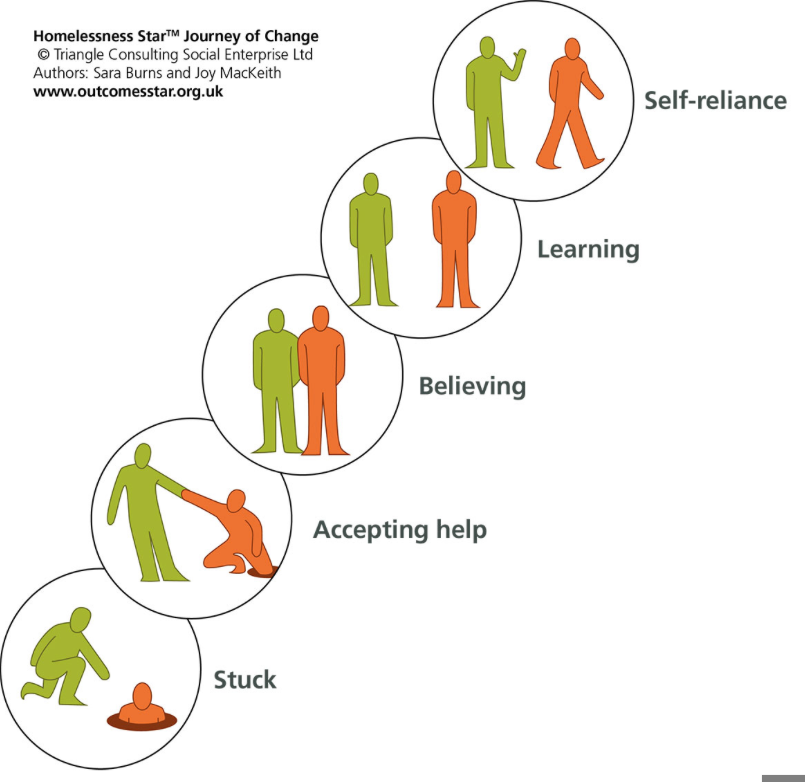
The Recovery Star has also proven to be highly adaptable. Burns and MacKeith (2011) reported that its structure has been reconfigured into multiple “Outcomes Stars” tailored to different service contexts, including young people, homelessness, substance use, and domestic violence. This adaptability has been critical to its success, allowing it to address a range of psychosocial challenges while retaining a recognisable structure across contexts.
Yet, the very features that make the Recovery Star accessible also raise challenges. Perkins and Slade (2012) caution that while the scoring system creates clarity, it also risks oversimplifying complex personal experiences. Reducing aspects of identity, self-esteem, or relationships to a single number may fail to capture the richness and nuance of recovery journeys. Moreover, when services focus on the numerical data rather than the collaborative conversations, the tool risks becoming a bureaucratic “tick-box” exercise, undermining its empowering intent.
In summary, the Recovery Star’s features—its ten holistic domains, collaborative scoring process, visual mapping, stage model of change, and adaptability—make it both practical and accessible. At its best, it provides consumers and practitioners with a shared language for recovery and a visual record of progress. At its worst, if used rigidly or solely for reporting, it risks stripping recovery of its complexity and reducing it to numbers.
Evidence Base and Effectiveness of the Recovery Star
When MacKeith and Burns (2008) first introduced the Recovery Star, their pilot evaluations with UK mental health services indicated that the tool was effective in engaging consumers in structured conversations about recovery. They reported that both practitioners and consumers valued the visual design of the star diagram, which made progress easier to conceptualise and discuss. For many participants, the collaborative process of completing the Star provided a framework for building trust, encouraging openness, and shaping future goals.
Building on this foundation, MacKeith (2011) argued that the Recovery Star was not only a measurement instrument but also a therapeutic intervention in its own right. By plotting progress across ten domains, consumers could see evidence of change that might otherwise be overlooked. This visual representation often served as a source of motivation and hope, validating even small steps forward. Practitioners, meanwhile, described the Star as a practical case management tool that allowed them to set goals with consumers and to revisit these goals periodically, creating a sense of accountability and continuity.
The broader literature also supports the value of structured recovery tools. Slade and colleagues (2008) highlight that frameworks like the Recovery Star can enhance recovery-oriented dialogue by ensuring that attention is given to strengths, values, and holistic domains, not just clinical symptoms. Their work reinforces the idea that structured planning tools are not merely assessment instruments but also conversation catalysts, capable of transforming the dynamic between consumers and services.
Despite these positive findings, significant critiques have emerged. Perkins and Slade (2012) raise concerns about the psychometric limitations of the Recovery Star. Because its ratings are generated collaboratively rather than through objective measurement, its reliability and validity are weaker than standardised outcome measures. This poses a problem when services use aggregated data from the Star to demonstrate effectiveness to funders or policymakers. As Perkins and Slade (2012) caution, the tool was never intended to serve as a purely scientific measure of outcomes, and misusing it in this way risks undermining both its credibility and its recovery ethos.
Another critique relates to the tension between empowerment and accountability. While MacKeith and Burns (2008) designed the Star to empower consumers by making recovery visible, its integration into service contracts and performance frameworks has sometimes transformed it into a bureaucratic requirement. Consumers may feel pressured to complete the Star as part of service compliance, rather than experiencing it as a collaborative and empowering exercise. This reflects a broader pattern in recovery practice, where tools designed to promote empowerment can be co-opted by systems focused on reporting (Perkins & Slade, 2012).
The cultural appropriateness of the Recovery Star has also been questioned. Page, Dudgeon, and Garvey (2022) argue that Aboriginal and Torres Strait Islander recovery is rooted in kinship, collective identity, and connection to Country, dimensions that are not captured within the Star’s ten domains. Similarly, Rees, Crowe, and Harris (2021) note that recovery models need to explicitly address stigma and identity affirmation for LGBTIQ consumers. In its current form, the Recovery Star reflects predominantly Western, individualised assumptions about recovery, and without adaptation, it risks marginalising those with different cultural perspectives.
In summary, the evidence base suggests that the Recovery Star is most effective as a collaborative planning and motivational tool. Its value lies in fostering dialogue, strengthening alliances, and making recovery progress visible. However, its limitations as a psychometric measure, its vulnerability to bureaucratic misuse, and its lack of cultural inclusivity highlight the need for caution. When used flexibly and in partnership with consumers, the Recovery Star can be empowering. When applied rigidly as an accountability mechanism, it risks undermining the very recovery principles it was designed to promote.
Application to Community Mental Health Case Management
The Recovery Star has found particular relevance in community mental health case management, where the focus is on supporting people to build sustainable lives in the community rather than on acute symptom stabilisation. In these contexts, the Star functions both as a collaborative planning tool and as a framework for reviewing progress over time.
As MacKeith and Burns (2008) explain, the Star was designed to be completed jointly by the consumer and the practitioner. This joint completion makes it especially suitable for case management relationships, which rely heavily on ongoing collaboration. By rating progress across ten domains, the consumer and case manager can co-construct a baseline profile of strengths and areas requiring attention. For example, a consumer may score highly in managing mental health but identify lower progress in social networks or employment. This provides a structured basis for goal-setting, ensuring that practical and psychosocial needs are addressed alongside clinical care.
One of the advantages of the Recovery Star in case management is that it facilitates structured recovery conversations. Anthony (1993) defines recovery as a deeply personal process of living a meaningful and satisfying life, and Bonney and Stickley (2008) emphasise that recovery involves reclaiming identity and purpose. The Star’s domains, particularly those addressing identity, relationships, and trust and hope, resonate strongly with these broader recovery concepts. Case managers can use the tool to prompt conversations that might not otherwise occur, such as reflecting on self-esteem or rebuilding social connections, thereby embedding recovery principles in everyday practice.
Another strength of using the Star in case management is the motivational effect of its visual tracking. As MacKeith (2011) observed, consumers often report feeling encouraged when they can see their progress mapped over time, even when changes are incremental. This is particularly important in community contexts, where recovery is often a long-term, non-linear journey. For case managers, the ability to revisit the Star periodically provides a consistent structure for reviewing goals, reinforcing hope, and adjusting support plans.
At a service level, the Recovery Star also offers a way to integrate accountability with personal recovery goals. Case managers can use individual Stars to guide consumer planning, while services can aggregate data across consumers to demonstrate outcomes to funders. This dual purpose is one reason for the Star’s widespread adoption (MacKeith & Burns, 2008). However, as Perkins and Slade (2012) caution, the risk lies in allowing the accountability function to dominate. If case managers focus primarily on producing scores for reporting, the consumer’s personal meaning can become secondary, and the collaborative ethos may be lost.
Cultural responsiveness is another critical consideration in case management. Page, Dudgeon, and Garvey (2022) remind us that for Aboriginal and Torres Strait Islander peoples, recovery is inherently collective, relational, and tied to spirituality and Country. These dimensions are not explicitly represented in the Recovery Star’s ten domains. Similarly, Rees, Crowe, and Harris (2021) emphasise that LGBTIQ consumers need recovery tools that directly address stigma and affirm identity. Without adaptation, the Star risks imposing an individualised, Western-centric view of recovery that may not align with consumers’ lived experiences. Case managers therefore need to use the tool flexibly, integrating culturally safe practices alongside it.
In summary, the Recovery Star can be highly effective in community mental health case management by structuring recovery conversations, motivating consumers through visual progress, and balancing personal planning with service reporting. Yet its application must remain flexible, culturally responsive, and consumer-centred. When used thoughtfully, it has the potential to strengthen case management relationships and embed recovery values in practice. When used rigidly, it risks reinforcing bureaucracy and overlooking the diverse realities of recovery.
Critical Discussion: Strengths and Limitations of the Recovery Star
The Recovery Star is now one of the most widely adopted recovery tools in community mental health services, and its popularity reflects both its accessibility and its ability to balance consumer involvement with service accountability. However, as with many recovery models, its strengths are accompanied by notable limitations that highlight the tensions between recovery philosophy and service systems.
One of its primary strengths lies in its holistic coverage of recovery domains. By including areas such as relationships, identity and self-esteem, and trust and hope, the tool expands the focus of mental health services beyond symptom reduction. William Anthony (1993) was among the first to argue that recovery involves living a meaningful life despite ongoing difficulties, and the domains identified by MacKeith and Burns (2008) resonate strongly with this vision. Consumers and practitioners alike have valued the breadth of the Star, noting that it legitimises discussions of psychosocial issues that are often overlooked in clinical practice.
Another strength is the collaborative ethos built into the tool. As MacKeith and Burns (2008) emphasise, the Star was designed to be completed jointly by consumers and workers, creating a process of shared reflection. Mike Slade and colleagues (2008) argue that tools which generate collaborative dialogue can fundamentally alter the therapeutic relationship, shifting the balance of power towards partnership and shared decision-making. For many consumers, this collaboration represents a welcome departure from top-down, professionally dominated assessments.
The visual accessibility of the Star is also an important strength. As MacKeith (2011) observed, many consumers reported that the simple star diagram provided a motivating and concrete picture of progress. The act of plotting change across domains can instil hope and highlight incremental achievements that might otherwise be overlooked. In addition, the model’s adaptability has been a key factor in its success. Burns and MacKeith (2011) documented the creation of a family of “Outcomes Stars” tailored to different populations, including young people, people experiencing homelessness, and individuals with substance use issues, making the tool versatile across diverse service settings.
Despite these strengths, the Recovery Star is marked by significant limitations. The first stems from its service-driven origins. Because the Star was developed within organisational contexts to address policy and funding imperatives, it has always carried a dual mandate: to empower consumers and to generate measurable data for services. Perkins and Slade (2012) caution that this origin makes the tool vulnerable to being used primarily as an accountability mechanism, potentially reducing personal recovery journeys to aggregated scores for commissioners and funders. In such cases, consumers may experience the Star less as a collaborative exercise and more as a bureaucratic requirement.
A second limitation is the risk of reductionism. While the ten domains are broad, compressing complex aspects of identity, relationships, and wellbeing into a single score on a 1–10 scale risks oversimplification. Perkins and Slade (2012) highlight that such simplification can undermine the richness of recovery experiences, particularly if practitioners prioritise producing scores rather than engaging in meaningful dialogue. This concern echoes wider critiques of outcome-driven practice in mental health, where numbers can obscure the lived realities of service users.
Cultural critiques further complicate the model’s application. Page, Dudgeon, and Garvey (2022) argue that Aboriginal and Torres Strait Islander recovery is inseparable from kinship, spirituality, and connection to Country, dimensions that the Recovery Star does not adequately capture. Likewise, Rees, Crowe, and Harris (2021) stress that for LGBTIQ consumers, recovery tools must explicitly address stigma, discrimination, and identity affirmation. Without adaptation, the Star risks reproducing a Western, individualised view of recovery that does not reflect the diverse cultural contexts in which it is now used.
Finally, there is the issue of implementation fidelity. While the Recovery Star was designed to be collaborative, its success depends on how practitioners use it. When workers approach it as a dialogue tool, it can foster empowerment and strengthen alliances. However, when used rigidly as a reporting mechanism, it risks disempowering consumers and reinforcing hierarchical practices. As Perkins and Slade (2012) point out, recovery-oriented tools are only as effective as the systems and cultures in which they are embedded.
In summary, the Recovery Star’s strengths include its holistic domains, collaborative ethos, visual accessibility, and adaptability, which together make it a practical and motivating framework for recovery planning. Yet its limitations—service-driven origins, reductionism, cultural narrowness, and challenges with implementation fidelity—illustrate the ongoing tension between recovery values and service accountability. The challenge for practitioners and organisations is to ensure that the tool is used in ways that preserve its empowering potential while addressing its inherent limitations.
Conclusion
The Recovery Star has become one of the most widely adopted tools for embedding recovery principles into mental health practice, reflecting its accessibility, adaptability, and resonance with contemporary service demands. Developed by Joy MacKeith and Sara Burns (2008) in collaboration with the Mental Health Providers Forum, the tool was designed to respond to both consumer needs for collaborative planning and service imperatives for measurable outcomes. Its ten domains of recovery and visual star diagram have made the often abstract concept of recovery tangible, while its collaborative process has strengthened therapeutic relationships and motivated consumers through visible progress.
The evidence base, as highlighted by MacKeith (2011), demonstrates that the Star is effective in engaging consumers and fostering recovery conversations. Scholars such as Slade and colleagues (2008) further emphasise that its collaborative ethos aligns with recovery values by shifting practice away from deficit-based assessments. At the same time, critiques from Perkins and Slade (2012) point out that its psychometric limitations and service-driven origins create tensions, particularly when the tool is used for accountability rather than empowerment. These tensions are compounded by cultural critiques from Page, Dudgeon, and Garvey (2022) and Rees, Crowe, and Harris (2021), who argue that without adaptation the Star risks reflecting a narrow, Western view of recovery that excludes Indigenous and LGBTIQ perspectives.
In conclusion, the Recovery Star represents both an opportunity and a challenge within the recovery paradigm. At its best, it provides a flexible and collaborative framework that fosters dialogue, instils hope, and makes progress visible. At its worst, it can be reduced to a bureaucratic exercise that oversimplifies recovery and privileges service reporting over consumer meaning. For the Star to fulfil its promise, practitioners and organisations must apply it with cultural sensitivity, fidelity to its collaborative ethos, and a focus on dialogue rather than scores. Only then can it remain true to the recovery values it was created to represent.
References
Anthony, W. A. (1993). Recovery from mental illness: The guiding vision of the mental health service system in the 1990s. Psychosocial Rehabilitation Journal, 16(4), 11–23. https://doi.org/10.1037/h0095655
Bonney, S., & Stickley, T. (2008). Recovery and mental health: A review of the British literature. Journal of Psychiatric and Mental Health Nursing, 15(2), 140–153. https://doi.org/10.1111/j.1365-2850.2007.01185.x
Copeland, M. E. (2002). Wellness recovery action plan and peer support: Personal, group, and program development. Peach Press.
MacKeith, J., & Burns, S. (2008). Mental health recovery star: User guide. Triangle Consulting Social Enterprise.
MacKeith, J. (2011). The development of the Outcomes Star: A participatory approach to assessment and outcome measurement. Triangle Consulting Social Enterprise.
Page, J., Dudgeon, P., & Garvey, D. (2022). Principles of social and emotional wellbeing for Aboriginal and Torres Strait Islander peoples. Australian Psychologist, 57(1), 12–24. https://doi.org/10.1080/00050067.2021.2002705
Perkins, R., & Slade, M. (2012). Recovery in England: Transforming statutory services? International Review of Psychiatry, 24(1), 29–39. https://doi.org/10.3109/09540261.2011.645025
Rees, S. N., Crowe, M., & Harris, S. (2021). The lesbian, gay, bisexual and transgender communities’ mental health care needs and experiences of mental health services: An integrative review of qualitative studies. Journal of Psychiatric and Mental Health Nursing, 28(4), 578–589. https://doi.org/10.1111/jpm.12720
Slade, M., Amering, M., & Oades, L. (2008). Recovery: An international perspective. Epidemiologia e Psichiatria Sociale, 17(2), 128–137. https://doi.org/10.1017/S1121189X00002827


Comments